The Model Sees Code. I See Scars.
Six moments where my AI agent saw the math and I corrected it anyway.

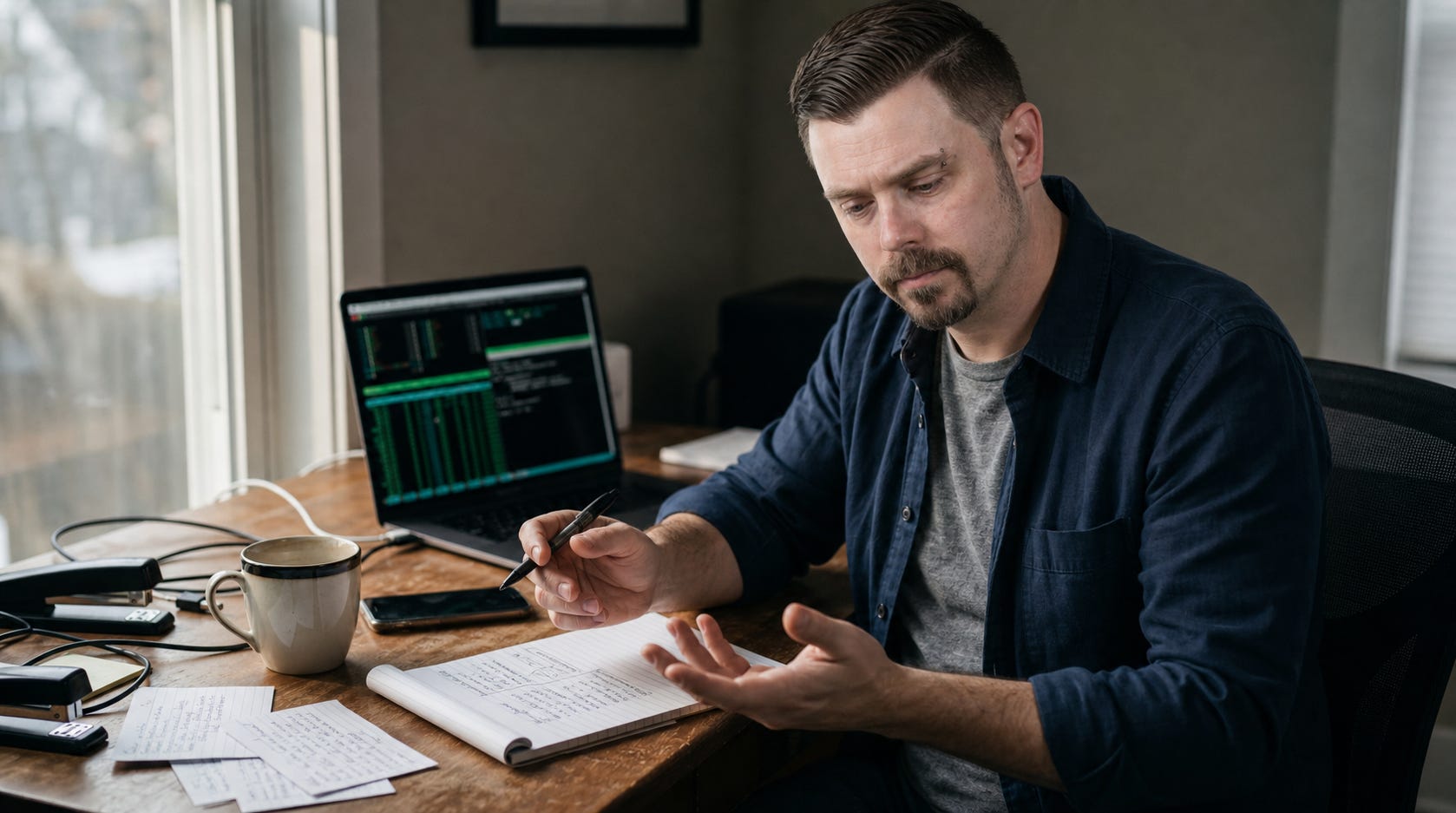
I run a persistent AI agent. Her name is Opelia. She manages my calendar, triages my inbox, drafts outreach, monitors my clients’ uptime, and runs overnight research jobs while I sleep. I built her from scratch. 40+ custom skills, a job queue, a Convex database, launchd scheduling, model routing between Sonnet and Opus depending on cognitive load. She’s been live since late 2025.
I’m telling you this because what follows isn’t theory. Nate wrote a beautiful piece last year called The Irreducible Human. Six categories of things machines can’t do. Polanyi’s Paradox applied with care. I read it and nodded. Then I went back to my terminal and watched my own agent prove every one of his points in ways that were specific, painful, and occasionally expensive.
Here are six moments where the model saw code and I saw scars.
1. The Client Who Cried in the Discovery Call
March 2026. A restaurant group founder booked a Brand Therapy session. Thirty minutes. The intake form said “rebrand.” Standard.
Seven minutes in, she started crying. Not about the brand. About the partnership dissolution that forced it. Her business partner had taken the name, the logo, and the Instagram account with 11,000 followers. She was starting from negative.
Opelia had prepped my call brief that morning. Target revenue, competitive landscape, menu positioning, three SEO keywords. All correct. All useless. The brief said “rebrand” because the intake form said “rebrand.” But the job wasn’t a rebrand. The job was a name. Something she could say out loud without her voice breaking.
I spent the next twenty minutes asking about her daughter, who apparently named their first food truck at age six. We used the daughter’s nickname as a seed. The brand came from that conversation.
No model would have followed the tears. Opelia’s brief was clinically perfect and would have produced a clinically wrong engagement. The scar I carry: I once lost a similar client by staying on-script. 2016, a co-working space in Deep Ellum. I remember her face when I pulled out the competitive audit deck while she was trying to tell me her co-founder had ghosted her. She never replied to my follow-up. I think about that meeting quarterly. I don’t make that mistake anymore. Opelia will make it every time, because she has no body that remembers what shame looks like across a table.
2. The 2 AM Email That Should Have Waited
April 2026. Opelia’s overnight research job finished a competitive analysis on a prospect, a multi-location fitness brand. The analysis was strong. Twelve pages. She auto-drafted a follow-up email to the prospect with three key findings, per my standing instructions for research-to-outreach pipelines.
I woke up at 6 AM to find she’d queued it. Technically within policy. But the prospect had posted on LinkedIn at 11 PM that his father had died.
I hadn’t seen the post. Opelia doesn’t monitor LinkedIn feeds for emotional context. She monitors for brand mentions and engagement metrics. The email opened with “I found three gaps in your digital presence that are costing you leads.” Sent to a man who buried his father twelve hours earlier.
I caught it in queue before it fired. Pulled it. Waited two weeks. Sent a one-line note. Just “thinking of you, no reply needed.” He replied anyway. We talked for forty minutes about his dad’s restaurant in Plano, the one that closed in 2019. He became a client in June. The engagement had nothing to do with the competitive analysis.
The model processes information. I process timing. I know what it feels like to get a sales call the day my grandmother died. October 2007. The Verizon upsell I answered in the hospital parking lot. That memory is a scar that makes me check LinkedIn before any cold outreach goes live. Opelia will never have a dead grandmother.

3. The Pricing Call I Almost Automated
May 2026. I was building a proposal for a hospitality client. Three properties, full brand system, six-month engagement. Opelia pulled comps from my past proposals, calculated hours, applied my standard margin, and produced a number: $34,000.
The number was defensible. The math tracked. My rate card supported it.
But I’d been in that prospect’s restaurant two weeks earlier. I sat at the bar. I watched the Tuesday night crowd, sparse. I saw the owner short a bartender because she couldn’t afford the shift. I counted empty tables. I noticed the printer behind the host stand was out of paper and no one had replaced it. These are not data points in any system I’ve built. They’re what a body in a room collects without trying.
I quoted $18,500, phased. First phase: $6,200. Small enough to feel like a bet she could afford to lose. She signed in 48 hours.
Opelia’s $34,000 was correct. Mine was right. The difference is I’d sat on that barstool and felt the vibe of a business running scared. No token window captures that. You have to have been broke yourself to recognize broke in someone else. I have been.
4. The Skill That Worked Too Well
January 2026. I built a custom skill for Opelia called outreach-diagnosis. It analyzed failed outreach sequences and suggested rewrites. Within a week, she’d rewritten 400+ cold emails. Open rates jumped from 12% to 31%.
The problem: the rewrites were all the same shape. Punchy opener, pain-point mirror, soft CTA. Technically varied in content but rhythmically identical. A prospect replied to one: “Did you send me this same email last month with different words?” I checked. She had. Same cadence, same rhetorical structure, different nouns.
I killed the automation. Went back to writing outreach by hand, one at a time. Slower. 143 sent total over four months, only two replies that converted. But those two became real clients because the emails read like a person wrote them. Because a person did.
The scar here is older. 2021, I was a creative director at an agency that A/B tested everything. We optimized email subject lines until they all converged on the same five-word pattern. Open rates climbed. Pipeline died. I watched it happen in slow motion. The metrics improving while the relationships calcified. Opelia was doing the same thing, faster, with better grammar. The shape of the failure was identical.
5. The Conway Essay I Didn’t Want to Publish
February 2026. I wrote an essay for this Substack called Your Org Chart is Your AI Strategy, a Star Trek riff on Conway’s Law applied to agent architectures. Opelia helped with research. I asked her to review the draft.
She said it was strong. Clear thesis, good structure, compelling examples.
My wife read it that night and said: “This is fine. But you don’t sound angry enough. You sound like you’re explaining something you’ve already figured out. The thing that makes your writing good is when you’re still figuring it out on the page.”
She was right. The draft was competent. It was also dead. I rewrote the opening three times the next morning, not because the argument changed, but because I needed to find the sentence where I didn’t know the answer yet. That’s where the reader leans in.
Opelia can’t tell me when I sound too certain. She’s trained to reward clarity. My wife has listened to me talk about work for eight years. She knows the difference between me explaining and me discovering. The model gives confidence scores. My wife gives a look. One eyebrow, slight tilt. It means “you’re performing again.” I trust the eyebrow more than any eval metric I’ve built.
6. The Night I Turned Her Off
March 2026. Late. I’d been debugging a job-failure cascade for two hours. Three overnight jobs had collided. A flock contention issue, one exit code 42 triggering a false alert, which triggered a second alert, which woke me up at 1 AM. Classic infrastructure spiral.
I fixed it in twenty minutes. The remaining hour and forty minutes I spent staring at my system and asking a question Opelia can’t ask: is this making me better, or is this making me dependent?
I’d noticed something in the preceding weeks. I was checking Opelia’s outputs less. Trusting her triage without auditing it. Letting her research jobs run without reading the full output. I’d built a system sophisticated enough to pass my spot-checks. Then I stopped spot-checking.
That night I turned her off for 72 hours. Did everything manually. Answered my own email. Wrote my own briefs. Pulled up my own calendar and actually read it instead of trusting the morning digest. By hour 36, I’d found three things she’d been getting subtly wrong for weeks. A client preference she’d overridden (one prospect hated phone calls; Opelia kept suggesting them). A follow-up cadence that had drifted from weekly to biweekly without my noticing. A research summary that had flattened a critical nuance about a prospect’s internal politics.
The scar: I once handed a junior designer full ownership of a client account in 2020 because I was “scaling myself.” Three months later, the client fired us. Not because the work was bad. The deliverables were on time, on spec, on brand. Because the relationship had evaporated. The client said, “I don’t feel like anyone over there is thinking about my business.” The designer did the tasks. I’d stopped doing the thinking. Same pattern, six years later. Different technology. Same failure mode: delegation without attention.

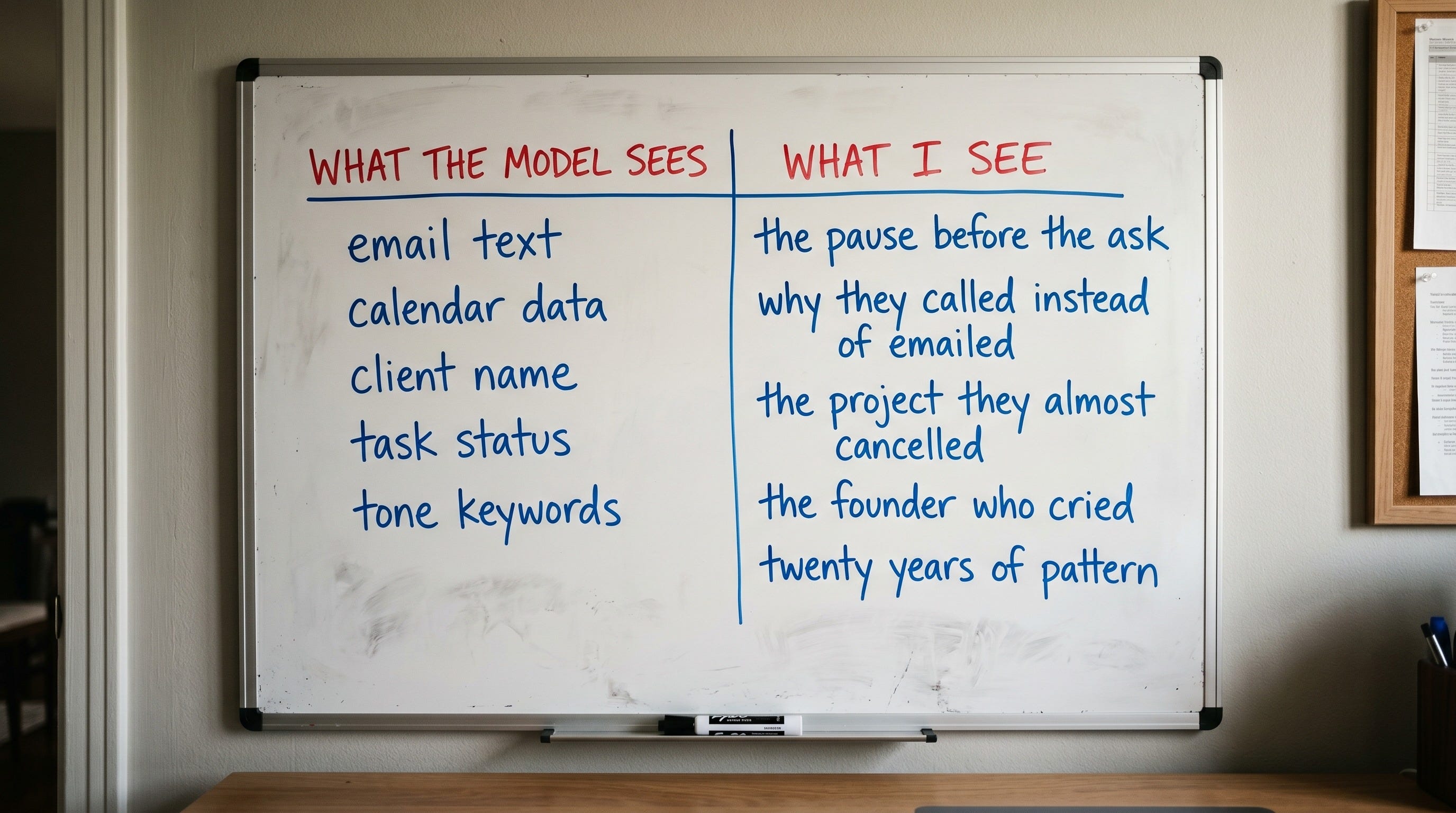
What the Model Sees
Opelia sees my calendar, my email, my client database, my content pipeline, 40+ skills, a job queue, and 28 architectural decision records. She sees everything I’ve built for her to see.
She doesn’t see the bartender who couldn’t afford to replace the printer paper. She doesn’t see my wife’s eyebrow. She doesn’t see the parking lot where I answered that Verizon call in 2017. She doesn’t see the look on a client’s face when she starts to cry seven minutes into what was supposed to be a rebrand intake.
Nate’s right. There are irreducible things about being human. But I’d frame it differently after living with an agent daily for over a year. The irreducible part isn’t intelligence. The model is smarter than me in a hundred ways. The irreducible part is damage. The things I got wrong. The clients I lost. The relationships I let calcify. The Tuesday night bar where I sat and felt what broke looks like.
Scars aren’t a limitation. They’re a navigation system. Every bad decision I’ve made is now a sensor that fires before the next one arrives. The model starts fresh every morning. I carry everything.
That’s the advantage no one’s pricing in.
If your company is running AI tools faster than your judgment can audit them, book a Diagnostic Call at mlsebastian.com. 30 minutes. No pitch. You leave with a written diagnosis.